From a USB Stick to Autonomous Access: Digitising the Pedestrian Zones of Bratislava's Old Town
Every morning the municipal police received an Excel file of permitted cars on a USB stick and matched it against camera feeds 24/7 by hand. We built an autonomous system where the on-site technology and our eVjazd software on the KALM:IT platform decide on entry themselves, including AI recognition of an ambulance or fire truck. And we keep it running.
Jozef Krivaček · 15/06/2026 · 11 min read
One USB stick, every morning
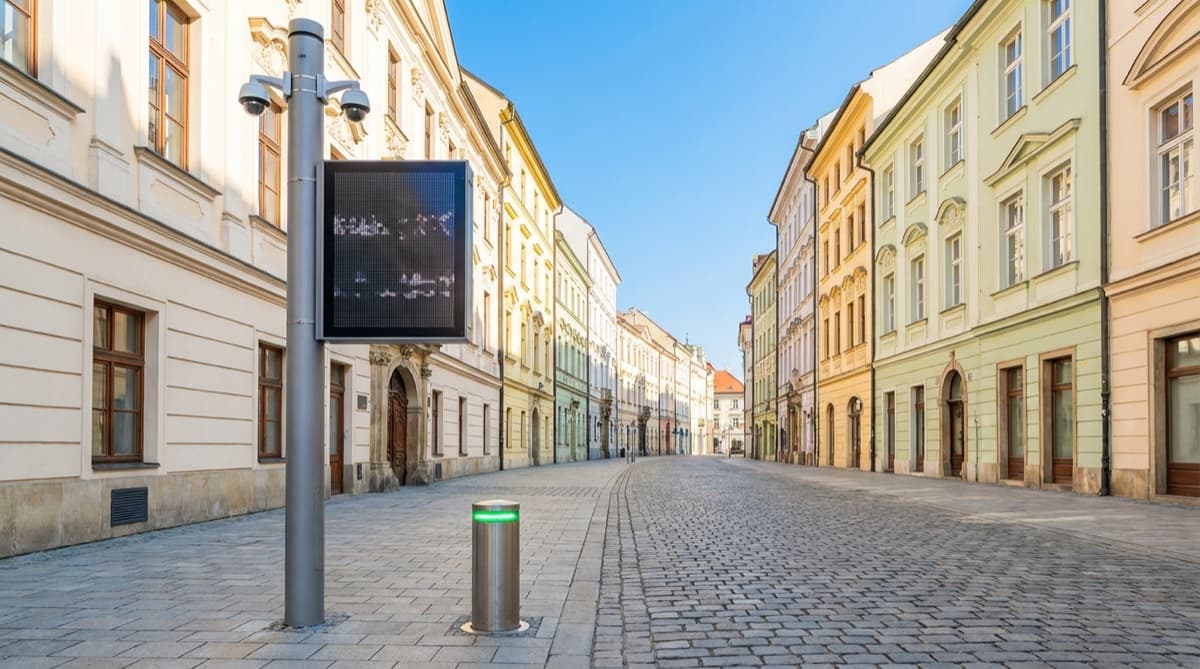
Every larger city's historic centre wrestles with the same tricky balance. On one side, pedestrian zones meant for tourists and for people who just want to walk without cars. On the other, the everyday reality: shops need deliveries, residents need to get home, waste has to be collected, the street swept, a car parked during a house move. Bratislava's Old Town district has several such zones, and for years it ran them in a way that sounds almost unbelievable today.
At the entrances to the centre stood retractable hydraulic bollards. Each of these points was wired into the city camera system and to the municipal police. And here is the key part: the list of vehicles allowed in travelled physically, on a USB stick, every single day. Someone at the town hall exported a spreadsheet each morning, copied it to the stick and carried it to the municipal police station on Medená Street. There, officers watched the cameras 24 hours a day. When a car pulled up to a gate, they compared its plate against the list by hand, checked that the time window matched too, and only then lowered the bollard and let it through.
There were two catches. The first is obvious: an enormous amount of manual work for something that ought to be pure routine. The second is more serious. The cameras had a slight lag, so when several cars followed each other closely, every now and then the bollard rose under one of them. As long as a live person is on duty around the clock, the human factor can never be fully ruled out, even with a traffic light and signage in place. In short, it just wasn't right.
The brief: replace round-the-clock staffing with a system that decides for itself
Old Town commissioned a working, autonomous, automated access-control system. Not a cosmetic touch-up, but the whole chain from permit registration to the physical gate, one that decides on its own and where a person only steps in to supervise the rare exception.
We built it as a single whole resting on two tightly linked pillars. On one side, software that knows who may enter. On the other, the technology right at the entry points that carries that decision out. The magic is in how the two work together, so let us take each one in turn.
The eVjazd software: a system that knows the city's rules
Entry into these zones is not governed by some arbitrary decision, but by a generally binding ordinance (VZN) issued by Old Town itself. And it does not know just one notion of "entry". It knows dozens of permit types, and each has its own clause and its own precise conditions:
- who may enter, e.g. a resident, a business, deliveries, a house move, street cleaning or waste collection,
- how long they may stay, e.g. deliveries until 9 a.m.,
- what vehicle weight is allowed (up to 3.5 t, over 3.5 t),
- and whether entry is charged or exempt, and if charged, whether annually, per single entry or per day.
A side note: the full rules are in the VZN on staramesto.sk, where you can look up the ordinance that governs entry into the regulated zones.
So that the office staff could actually work with all of this, we built them an information system called eVjazd. It is the registration and tax side of the whole solution: a clerk at the client centre enters the vehicles of people who come in person to buy a specific permit type, and the system keeps the tax agenda exactly in line with what the VZN says about that entry. eVjazd thus faithfully mirrors the city's ordinance, prices and all the exemptions included, and keeps a complete record of users and of individual transits. The district can therefore look back at any time and see which vehicle passed where and when.
The technology at the entry points: what actually decides on the spot
There is more at the entry and exit points than meets the eye. At each location we have:
- at least two ANPR cameras that read the vehicle's number plate on their own,
- at least two overview cameras that capture the surroundings, and where possible the face, colour and distinctive features of vehicles coming and going,
- a large LED board that tells the driver the result, whether the passage is allowed or not,
- transit cameras that document any offence (for example, when a driver runs a red light and causes damage),
- dedicated network controllers that open and close each passage remotely,
- and our own network infrastructure with a mini-server right on site.
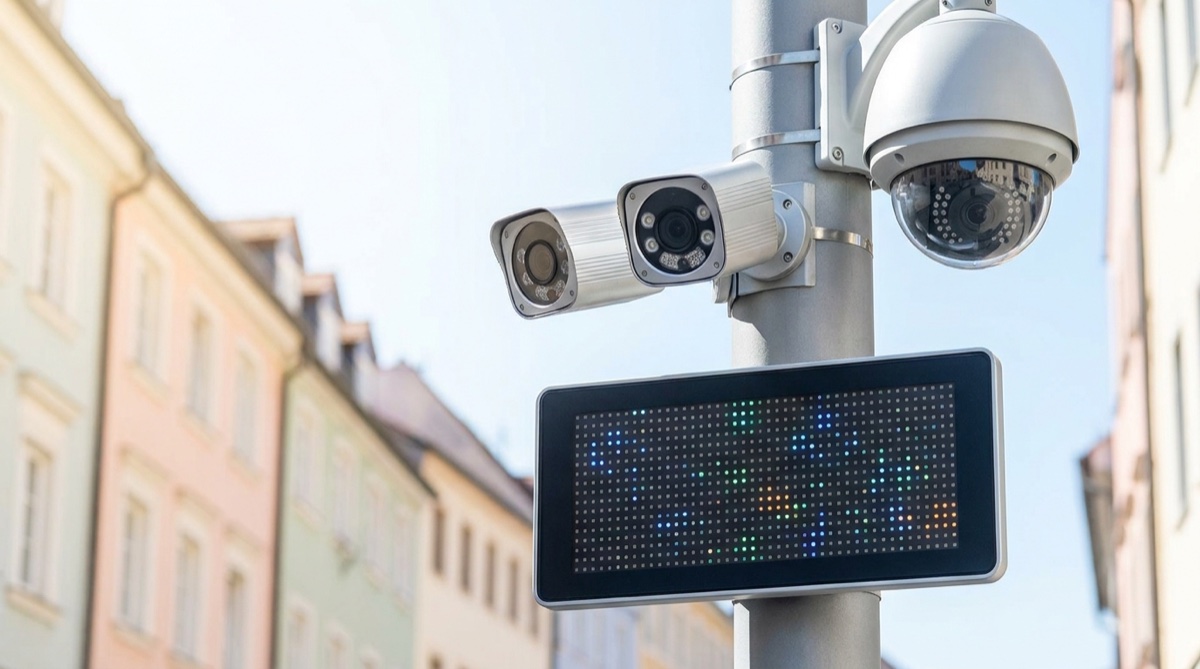 A pole at the gate carrying two ANPR cameras, an overview camera and an LED board that announces the result to the driver.
The loop of a single entry is surprisingly simple. The ANPR camera reads the plate, the local server asks the eVjazd system whether this vehicle may enter on this date, at this time and under the given conditions, the LED board shows the result, and based on it the bollard (or barrier) either stays put or lets the car through. All of it in a matter of seconds, with no one having to lift a finger.
The municipal police remain in this model, but their role has flipped. They are no longer a round-the-clock operator; they are oversight. When the system judges a vehicle invalid, it usually cannot be let through any further, and if an operator does so anyway, the system notes it and that resident can be taxed later.
KALM:IT and custom development: when the system spots an ambulance by itself
This is where our solution parts ways with an ordinary "read the plate, open the gate" barrier. We built it on our own KALM:IT platform and added development tailored exactly to what Old Town wanted.
The toughest requirement read: the system must recognise first-responder vehicles on its own, with no human input, i.e. ambulances, fire trucks and police. When such a vehicle pulls up to a gate, it usually already has its warning device on (a light signal is enough, no siren needed), and artificial intelligence evaluates how closely its appearance and characteristics match the predefined emergency vehicles. If the match is strong enough, the vehicle passes immediately, with no further checking, and stays flagged as an emergency vehicle.
A further step builds on that. A person can review the flagged transit afterwards, and if it really was an emergency unit, they can add the vehicle permanently to a whitelist. Whitelisted vehicles no longer even query the eVjazd system: the moment a gate camera catches them, they pass with priority, even during a minor outage or on a slow connection. And in an emergency, where seconds decide everything, that is the difference between an open road and a closed one.
Robustness: it works even when the internet or the power goes down
A system that controls entry into a city centre must not fail quietly. So we built that safeguard straight into its foundations.
The server at the gate runs on its own operating system and is backed by a UPS, an uninterruptible power supply. Even if the site is cut off from the internet or the mains, the server can keep running on its own for a good long while: processing events, counting daily entries and sending the data the moment the connection returns.
The response to a fault matters most. If the fibre is cut, the power or the internet drops, or important links go missing (such as the connection to the municipal police), the system detects it and all traffic devices release automatically, so that emergency services can get in if needed. The LED board lights up with an out of service notice and the traffic light turns green. And even in this state the system keeps recording transits and decrements daily entries. Safety comes first, but the record never goes anywhere.
Bollard versus barrier: why Židovská Street got a gate arm
The solution is not identical at every gate, because the gates are not identical either. The first zone has entries and exits from Straková and Františkánska streets; a separate second zone serves Židovská. And it was on Židovská that we eventually made a change.
A hydraulic bollard is durable, but it is a piece of steel with its own operating logic. For safety we set it so that after each passage the light first stays red for 6 seconds, and only then does the bollard start to rise. In a pedestrian zone that makes sense, six seconds is plenty for a vehicle to stop, even reverse a little, and to make it clear to everyone that there is nothing to do here on red. But it also means lower throughput, because each next car has to wait longer.
Židovská added one more factor: a narrow entrance. When a vehicle struck the bollard there several times, traffic on the street ground to a halt for a while and people couldn't get to work. So we swapped the bollard for a parking barrier. It is faster, works more dynamically, and has three practical advantages:
- a faster cycle, the barrier closes as soon as the vehicle passes and can read the next car more than those 6 seconds sooner,
- higher throughput, so no queues or needless collision situations build up,
- and driver familiarity, since people know barriers from shopping centres and pass through more calmly.
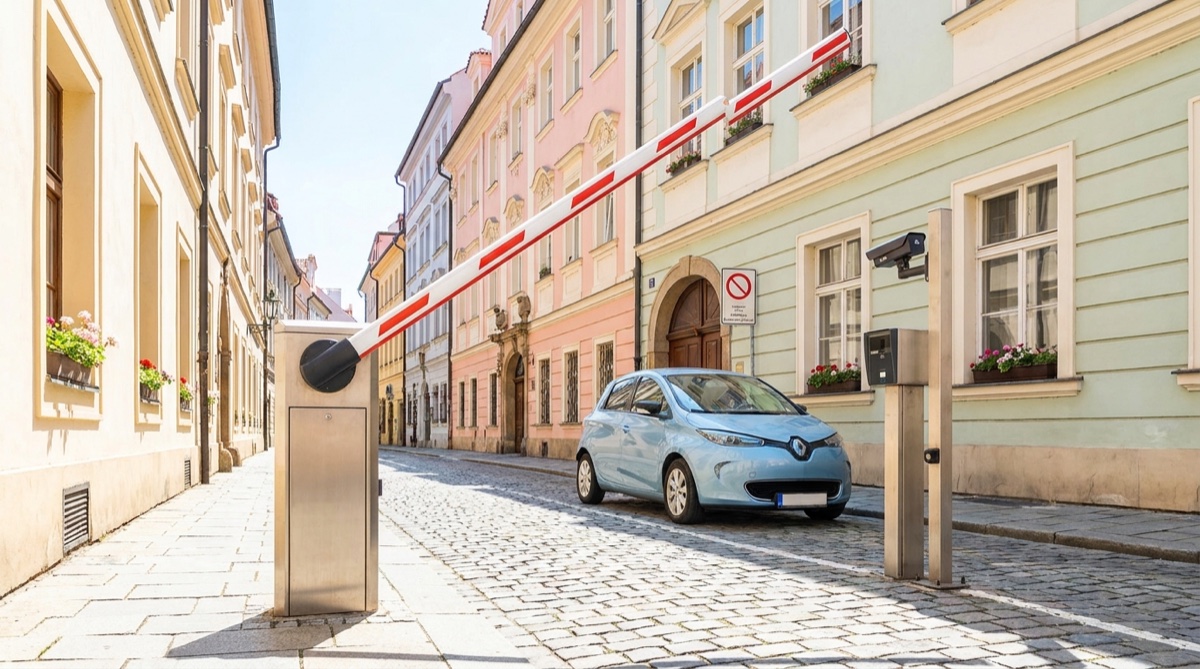 A parking barrier with an ANPR pillar at the narrow entrance to Židovská street, faster and smoother than the hydraulic bollard.
This is exactly the kind of decision you will never read off a datasheet. It came out of real operation, and out of the fact that we can fine-tune the system to a specific street.
Exit free, offences still caught
At the exit of any zone we chose to release every vehicle automatically. The reason is purely practical: any other approach would build long queues at the exit. That does not mean offences slip away. If a vehicle broke its permit conditions, for example it was meant to leave the zone within 30 minutes but the driver stayed longer, the system stores it in a database, where such offences can be looked up afterwards and the vehicle keepers taxed in a separate proceeding.
Service: building it is not enough, you have to look after it
A system that decides on entry into the city centre 24 hours a day needs someone who stands behind its uninterrupted operation. So the solution is not only supply and installation, but also ongoing service of the whole chain, from the ANPR and overview cameras through the LED boards, traffic lights, bollards and barriers to the network infrastructure and the local servers. And this is where it pays off that the hardware and the software come from one workshop: when something needs tuning or fixing, there is no hunt for a culprit among several vendors, we handle it as one whole.
The result: a year of autonomous operation
The Bratislava Old Town district now runs the eVjazd system, in which, on the basis of its own VZN, it registers every permit type along with prices and exemptions, keeps a record of users and has an overview of individual transits. At the entry points, the technology operates with enough autonomy that it needs no constant staffing, and the municipal police step in only at exceptional events. A process that until recently was 90% analogue is, in 2026, fully digitised.
The system has been in live operation for more than a year. In that time there were also several traffic accidents, but each was investigated by the Regional Traffic Inspectorate, which in every case found that it had been caused solely by the driver, who ignored the Stop! signal on red. And that, in the end, is the best proof that the system does exactly what it should, and does it reliably.
Are you tackling pedestrian-zone access, resident parking or entry control to the centre in your city? Get in touch. Together we will go through the locations, the rules of your ordinance, and what can be deployed as a tailored autonomous system, from the cameras and gates to the software that runs them.
Jozef Krivaček
CEO, omnius