What a Region Gains When It Starts Measuring Its Own Traffic
Before an election, every region talks about traffic, yet hardly any of them knows how many cars actually use its roads. What changes when a region starts measuring traffic itself, and how to build it so it outlasts the election cycle.
Jozef Krivaček · 04/09/2026 · 8 min read
This autumn Slovakia elects its regional governors and councils, and in every region people will be talking about traffic. About trucks cutting through villages. About the car park below the castle where you can't find a space by ten on a Saturday. About the road that was supposed to be repaired under the previous governor.
In the years we have worked with cities and regions, I have noticed one thing. When someone at a council meeting asks how many cars actually use that road each day, the room goes quiet. A region manages hundreds of kilometres of second- and third-class roads, but the numbers it has come from the national traffic census. The Slovak Road Administration runs it once every few years, most recently in 2022 and 2023; the next one is due in 2026 and the results won't be out until 2027. That is fine for planning motorways. For deciding whether to ban trucks from a particular village or which of three roads to repair this year, it is a years-old figure from a single counting day.
This article is about what changes when a region starts measuring traffic itself. Not megapixels and protocols, but decisions.
What we actually measure
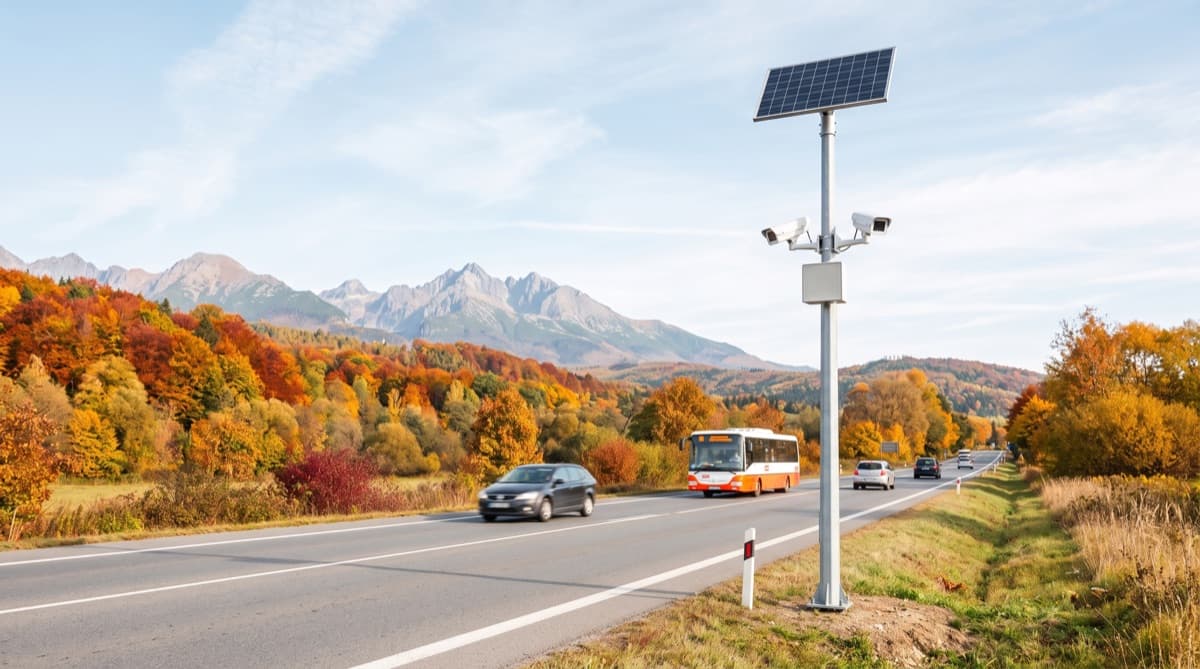
Most people picture traffic monitoring as a camera on a pole. In practice it is a combination of several devices, each with its own job. A camera with analytics counts vehicles, tells a car from a truck or a bus, and reads the number plate, so we know whether the same vehicle just passed through the village or stopped there. A radar or an induction loop in the road surface gives precise counts and speeds at night and in fog, when a camera sees less. Above a car park, one camera is enough to report how many spaces are free. And where there is no power or signal, on mountain roads and at forest car parks, a self-powered mobile tower does the measuring.
Out of all that come answers to questions a regional office currently settles by guesswork. How many vehicles pass through the village on a weekday and how many on a Saturday. What share of them is transit. When the park-and-ride fills up and what the cars do afterwards. Where the speeding is worst.
Five things a region does differently with data
The order of road repairs
There is always less maintenance money than there are sections that need it. Today the order of repairs is a mix of technical condition, complaints and politics. When a region knows how many vehicles, and above all how many heavy vehicles, use a road each day, it can say which road is wearing out fastest and where a repair will last longest. That is an argument you can explain even to the mayor of the village that didn't make the list this year.
Banning transit
A ban on trucks above a certain weight on a third-class road has to be defended before hauliers, the police and the ministry. With data on how many trucks passed through the village and where they came from, it is a different conversation. And once the ban is in force, the same cameras show whether anyone takes it seriously.
Car parks and visitor numbers
Say the car park below the castle has two hundred spaces and five hundred cars arrive in season. The region can't change that, but it can work with it. It tells the driver on the web or in the sat-nav that the car park is full before they get there. It runs the shuttle bus from the park-and-ride in exactly the hours it is needed, not all day empty. And when it plans a new park-and-ride, it builds it where cars actually circle, not where a plot happened to be free.
Objective liability
Speeding in a village, or a truck entering a zone it isn't allowed in, can now be handled with a fine to the vehicle keeper without a patrol stopping anyone. We described how that works on the software and hardware side in our series on speed cameras. The important thing is that it doesn't need another system. The cameras and radars that count traffic can do this too.
Negotiating with the state
A bypass or a relocation of a first-class road is not a regional investment but a state one. A governor who arrives at the ministry with two years of traffic intensities from their own measurements has a different conversation from one leaning on a residents' petition. Not because the petition doesn't matter, but because a number is harder to put aside.
Mountain and spa regions
A region with an industrial park has predictable traffic: a morning and an afternoon peak, Monday to Friday. A mountain or spa region works the other way round. On Tuesday the road into the valley is empty; on Saturday morning after snowfall there is a queue from the turn-off on the main road. And precisely where measuring would help most, at the car park below the resort or at the entrance to the valley, there is usually no power connection.
That is why in such places we advise against starting with fixed installations. For one season we put up our mobile TechTower, which has its own power, cameras and sensors, and within a few months the region knows where and when the problem really happens. Only then does it make sense to decide on a permanent installation. Building fixed points on an estimate and finding out a year later that the peak is two kilometres further on costs more.
So it doesn't end up as another system nobody looks at
We have seen enough projects that were launched with a ceremony and a year later all that was left was a dashboard nobody opens. In my view four things decide it.
The first is one place for all the data. Cameras from one manufacturer, radars from another and parking sensors from a third, each with its own portal, is something nobody will keep an eye on. The data has to flow into one platform where the region's traffic engineer, the municipality and the dispatch centre can all see it. We use our own KALM:IT platform for that; in Bratislava, for instance, it runs the Park & Ride analytics on top of the city's cameras.
The second is that the data can be shared. The municipality, the police and the Slovak Road Administration all benefit from the same numbers. The system should have an open interface, not a format only the supplier holds the key to.
The third is personal data. A number plate is personal data and the controller is the region, not the company that mounted the cameras. Where the recordings are stored, who can access them and when they are deleted should be part of the project from day one. We keep data in the EU or directly on the region's infrastructure.
The fourth is service. A camera on a mountain road breaks in January, not in May. We operate over 1,700 cameras and have technicians in Bratislava, Žilina and Michalovce, so we set out for a critical failure within four hours anywhere in Slovakia. A supplier whose subcontractor sits at the other end of the country will find a slot in the calendar.
How to pay for it
A region doesn't have to pay for this from its own budget alone. The Ministry of Investments, Regional Development and Informatization (MIRRI) has a dedicated measure for smart cities and regions in the Slovakia Programme 2021–2027, issues calls under it, and also funds expert smart-agenda teams directly at regional governments and in regional capitals. The calls and their deadlines change; the current state is at mirri.gov.sk and smartcity.gov.sk. In our experience one thing holds: a region that has a pilot behind it and knows exactly what it wants to measure and why writes a better project than one starting from a blank brief.
What remains after the election
A pilot launched this autumn will have its first data from a full winter season by spring, and within a year a time series the new regional leadership can lean on. Every candidate can promise to fix traffic. A region with its own numbers can actually keep the promise.
If you are preparing something like this for a region or a city, whether a one-season pilot or a permanent system on top of the cameras you already have, write to us. We'll come back with a proposed scope and technical solution.
Jozef Krivaček
CEO, omnius