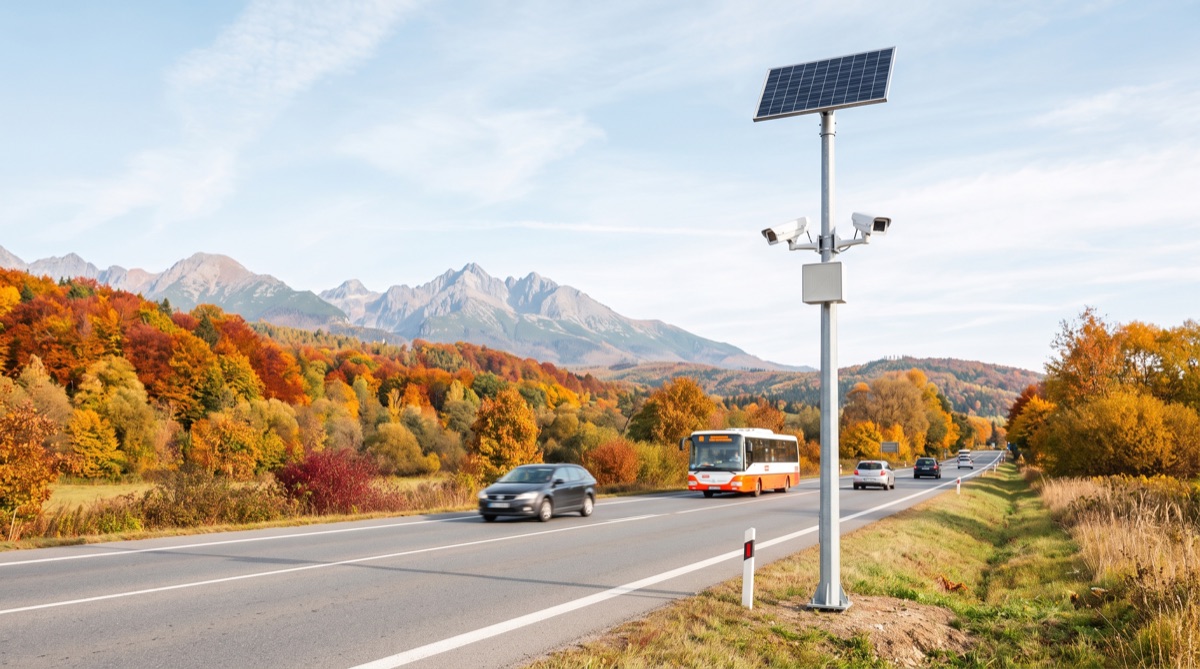
The Municipality Knows Where Drivers Speed. It May Not Measure It
The Slovak government promised municipalities their own speed cameras from May 2026. Parliament struck that from the amendment and left a model in which the town buys the camera and leases it to the state. The chief of the Bratislava Municipal Police knows of no town that has done so. What happened, why it does not work and what a municipality can do today.
Jozef Krivaček · 22/11/2026 · 5 min read
In November 2025 the Slovak government approved an amendment under which towns and villages were to operate their own fixed speed cameras from May 2026. They were to fine drivers for speeding, running a red light and ignoring a no-entry sign. Half a year later parliament struck that part from the law. The amendment has been in force since September 1, 2026, and municipalities still may not measure speed.
I am writing about this because we have worked on the topic for a long time. We build the software and the devices that can handle this kind of work, and we have written about both on this blog. After the law changed, we had to correct both articles.
What is left of the proposal
A municipality may install a fixed speed camera as the road manager. Measuring speed and fining for it remain with the police. The municipality would buy the device, mount it and lease it to the Ministry of the Interior.
Miroslav Antal, chief of the Bratislava Municipal Police, said on November 20 at a conference of municipal police forces that he knows of no municipality that has done this. He added: "Let us not put forward hybrid proposals like these, which do not solve the situation at all."
I understand him. The municipality would pay for a device whose operation it does not control. No council would approve that purchase.
Why municipalities should be able to do this
A mayor knows which school drivers pass in the morning faster than they are allowed to. The mayor hears it from parents, from the head teacher, and sees it from the office window. The state police are responsible for a whole district and cannot stand outside one school every day.
The state is meanwhile buying its own network. The Ministry of the Interior's tender covers 279 devices for more than 64 million euros, 213 of them fixed speed meters. That is a lot, but Slovakia has almost 2,900 towns and villages. Most of them will not get one.
Neighboring countries have already solved this. In the Czech Republic the municipal police may measure speed at locations approved by the state police. Prague, Karlovy Vary and Kostelec nad Orlicí all do it.
What people fear, with good reason
The main objection to municipal speed cameras is that they will turn into a cash machine: a camera on a straight road outside the village where nothing has ever happened, and a budget patched with fines. The fear is justified and the law should account for it.
Three rules are enough. The police approve each location based on accident records, as in the Czech Republic. The list of measured locations is public. Revenue from fines may be spent only on road safety, meaning crossings, lighting and pavements. A municipality that wants to measure outside a school will have no trouble with rules like these.
What can be done now
Until the law matures, a municipality does not have to sit and wait.
It can measure without fining. It may count cars and their speed, it just cannot issue a fine from that. Six months of data on how many cars pass the school and how fast carries more weight than a complaint from parents. With that in hand a municipality can ask for a patrol, for a state camera or for a change in road signs.
It can deal with stopping and parking. Here owner liability (the objective liability of the vehicle keeper) works for municipalities, and a camera that reads number plates documents the offence without a patrol.
It can control access. In Bratislava's Staré Mesto (Old Town) borough, access to the pedestrian zones is run by a system that reads the plate and decides on its own whether to lower the bollard. We described it in the article From a USB stick to autonomous entry. A car that has no business in the zone does not get in.
What comes next
The Municipal Police Act dates from 1991. The new draft is stuck in the comment procedure and little time remains before the parliamentary election in September 2027. Antal doubts it will be passed in time.
I think it will come anyway. Pressure from towns is growing, the neighbors have solved it and the state camera network will not cover every village.
We are following the legislation. The software that turns an offence into a decision and delivers it, and the certified devices that go with it, are described in our series on speed cameras. Once the law opens speed measurement to municipalities, we are fully ready.
Until then it makes sense to start with data. If you want to know what really happens outside your school or on the road through your village, write to us.
Sources: TASR, November 20, 2026: Municipal police forces keep calling for a change in legislation (in Slovak) · Noviny.sk, May 27, 2026: The new law brings several changes (in Slovak) · Act No. 8/2009 Coll. on Road Traffic (in Slovak) · Peniaze.sk: 279 speed cameras are coming to the roads (in Slovak) · Azet.sk: The Czech Republic introduces speed cameras in municipalities (in Slovak)
Jozef Krivaček
CEO, omnius